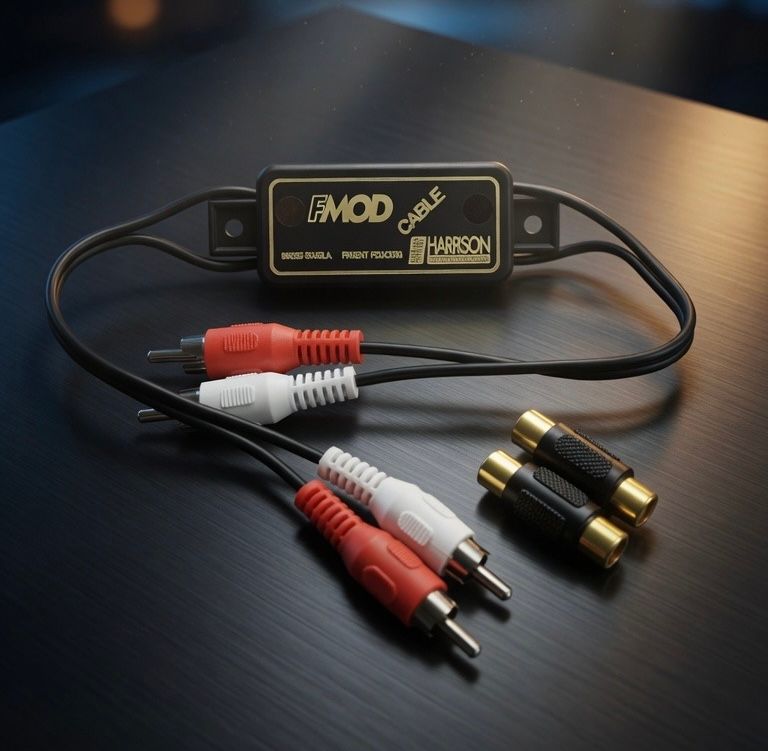
Fmod Cable Low Pass
$39.50
Low Pass Frequency Range
Please choose
1
Save this product for later
Fmod Cable Low Pass
Product Details
The Ultimate Noise-Free Solution for Precision Audio Filtering
Upgrade your audio system with the flexibility and precision of Harrison Labs FMOD Crossover Cables. Unlike standard rigid crossovers, these cable-style inline filters provide a space-saving, flexible solution that integrates seamlessly into tight amplifier racks or behind head units. Engineered and manufactured in the USA, FMOD cables offer a high-fidelity alternative to bulky electronic crossovers.
Key Features & Benefits:
- Dual-Frequency Versatility: Each cable is engineered with two distinct crossover points. Simply reverse the direction of the cable to select the frequency that best suits your acoustic environment.
- Passive Precision: As an "active crossover simulator," the FMOD cable requires no power to operate. This passive design eliminates the risk of induced power noise, ground loops, and "turn-on thumps," ensuring a dead-silent floor and pure signal path.
- Enhanced Power Handling:
- High-Pass (Red Label): Protects smaller speakers from damaging low-end frequencies, allowing them to play louder and cleaner.
- Low-Pass (Black Label): Filters out high-end chatter, delivering tight, focused bass to your subwoofers.
- Industry-Leading Accuracy: Experience professional-grade filtering with a ±1% accuracy rate (at 22k ohms), ensuring your speakers cross over exactly where they are supposed to.
- Steep 12dB/Octave Slope: Provides a clean, musical transition between drivers without the phase issues often associated with cheaper filters.
- Infinite Customization: FMOD cables can be "stacked" with other FMOD products to create custom bandpass ranges or steeper slopes, giving you total control over your soundstage.
- Maximum Signal Integrity: Supports up to 20 Volts RMS maximum input, making them compatible with high-output head units and professional audio gear.
- FMOD Cables have 6 inch male RCA pairs of cable stubs with RCA male plugs at each end with a detachable pair of double sided female end connectors. There are 2 crossover frequencies depending on the direction of insertion. For example, the 50/70hz FMOD Cable in one direction is 50hz and the other direction is 70hz.
Proudly Made in the U.S.A.